You don’t need equipment, a plan, or experience to start, just this.
If you’ve been putting off starting because you don’t know where to begin, this is exactly the kind of routine to start with.
No gym membership. No equipment. No complicated programme.
Just a handful of simple movements you can do in your own space, however small it is.
Why Simple Beats Complicated When You’re Starting Out?
It’s tempting to think you need a proper “programme” before you can start training seriously.
In reality, the best routine when you’re starting out is often the one simple enough that you’ll actually do it.
A structured programme can become useful as you progress. But in the beginning, the goal is simply to build the habit of showing up.
Complexity shouldn’t be the thing that stops you from starting.
The Routine
Four movements. No equipment needed.
Do this 2–3 times a week, ideally on non-consecutive days, so your body has time to recover between sessions.
- Squats
Stand with your feet roughly shoulder-width apart. Lower your hips back and down as if you’re sitting into a chair, then stand back up.
Squats work your legs and glutes and are one of the simplest movements to learn when you’re starting out.
- Push-Ups
Full push-ups if you’re comfortable with them. If not, start with knee push-ups or an incline version with your hands on a sturdy elevated surface.
Either way, you’re practising a pushing movement while building upper-body strength.
- Plank
Hold a straight-arm or forearm position while keeping your body in a comfortable straight line. Planks train your core to resist movement and can be surprisingly challenging when you’re new to them.
Start with a hold you can maintain with good form rather than trying to last as long as possible.
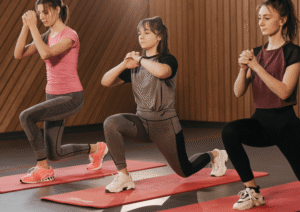
- Lunges
Step forward, lower your body in a controlled movement, then push through your front foot to return to standing.
Alternate legs. If you’re still working on your balance, you can hold onto a stable surface for support.
Lunges combine lower-body strength with balance and coordination.
Your Starting Structure
Do 2–3 sets of each movement, resting around 60–90 seconds between sets.
For your first couple of weeks, stick with 2 sets. Once that starts to feel manageable, you can add a third.
That’s the whole routine. No complicated splits. No equipment. Nothing to overthink.
A Few Things That Actually Matter More Than People Expect
Form over speed
Don’t worry about how quickly you can finish your reps.
Focus on controlled movements and a range of motion that feels comfortable for you. If you’re unsure about your technique, slow down and practise the movement before adding more repetitions or difficulty.
Missing a day isn’t a failure
A schedule is a guide, not a test. If you miss a session, don’t write off the entire week. Just pick your routine back up the next time you can.
Progress is gradual, and that’s normal
You probably won’t feel dramatically different after one week. Give yourself time to learn the movements and build consistency. As exercises become easier, you can gradually increase repetitions, sets or resistance.
You don’t have to do everything at once.
Why Your Floor Matters More Than You’d Think?
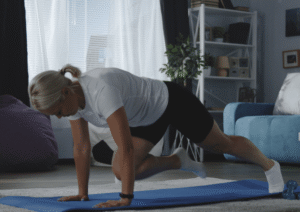
You don’t need gym equipment for this workout, but you are still going to spend a lot of time training on, and loading against, the floor.
Push-ups and planks put your hands, forearms and body directly against the surface. Squats and lunges also require a stable base underneath your feet, particularly when you’re still learning the movements.
A hard wooden or tiled floor can be uncomfortable for some floor-based exercises, especially when you’re training regularly.
A dedicated rubber training surface can provide some cushioning, a stable anti-slip surface and a defined area for your workouts.
And there’s another benefit to having a dedicated training area: it gives your workout a clear place in your home. As we covered in our article on why a dedicated workout space can help with consistency, reducing the friction around getting started can make it easier to turn exercise into a regular part of your routine.
Ready to Set Up Your Space Properly?
You don’t need a full room or a collection of equipment to start this routine.
You just need enough floor space to move comfortably and a surface that’s suitable for how you plan to train.
If you’re looking for a more durable training surface for your home gym, our 20mm Rubber Gym Mats are designed for home and garage training, with an anti-slip surface and properties that help reduce noise and vibration.
Whether you’re starting with bodyweight exercises or eventually adding dumbbells and heavier equipment, a dedicated training area gives you a solid foundation to build on.
Start simple. Build the habit. Add more when you’re ready.